
Hosts
FAQs
Hosting a Homestay Student
To help you navigate our frequently asked questions page, you can click on the question to expand the answer.
Can’t find an answer to your specific question? Please contact the homestay team at: homestay@wvschools.ca
What are the meal requirements?
Host families are expected to provide breakfast, lunch, and dinner each day, along with reasonable snacks in accordance to the Canadian Food Guide . Meals must also be provided on weekends, although mealtimes may be more flexible and should be discussed in advance between the host family and the student.
The following examples are intended to illustrate typical meal arrangements rather than prescribe specific menus:
Breakfast
A typical Canadian breakfast may include items such as cereal, toast, waffles, eggs, pancakes, fruit, milk, juice, or tea.
Lunch
On school days, host families provide a packed lunch. This commonly includes a sandwich or similar item with meat or cheese, fruit, and a snack, along with a drink. Many students prefer to prepare their own lunches, and preferences should be discussed directly between the student and host family. Leftovers or simple prepared foods may occasionally be used when appropriate.
Dinner
Dinner generally consists of a main dish, at least one vegetable, and a starch such as rice, potatoes, or pasta. Meals should include a protein component every day. If a student will be returning home late, a prepared meal should be made available in advance.
What are the expectations for specific dietary requests and needs?
Special dietary requirements are not included as part of the standard homestay agreement. Students are responsible for purchasing specialty food items when required. In some cases, additional fees may be assessed by the Homestay Coordinators to offset higher food costs related to special dietary needs. Details regarding dietary accommodation fees are available on the Exceptional Dietary Request Fee page. Specific dietary requests must be listed on the student’s application and will be communicated with host families at the time of placement.
How long does a student stay in West Vancouver?
The majority of students participate in the program for one or two academic semesters. One-semester placements typically run from September to the end of January or from February to the end of June. Students enrolled for a full academic year reside with their host family from September to June. In some cases, students choose to return for an additional school year, and a small number remain for multiple years and complete graduation within the program.
What is the student selection process? Is English language mandatory?
Students are recruited by West Vancouver Schools International Program staff and authorized agents. As part of the admission process, students:
- Complete academic and behavioural reviews
- Sign required legal agreements
- Agree to follow their school’s Code of Conduct
- Participate in comprehensive orientation sessions covering life in Canada, including homestay expectations
While all students have prior English language instruction, proficiency levels vary. Host families are encouraged to communicate clearly and patiently, allowing time for adjustment. Respectful, supportive communication helps students build confidence as they adapt to using English in daily situations.
What are the eligibility requirements to host a student?
Host families may be traditional or non-traditional and may include one or more host parents, with or without children. Family structures, routines, and lifestyles vary across our homestay community. All participating families share a commitment to providing a respectful and supportive living environment for students.
Families currently hosting students through another school or agency are asked to contact the homestay team for further information. Eligibility to host a West Vancouver Schools high school student depends on factors such as the age and gender of the student already in the home, as well as program guidelines.
As there are a limited number of homestay families available in the Vancouver area, it is now required that in some cases two students who share the same home language will live together in one homestay.
Students are unlikely to spend much time speaking their own language at home. In our experience, the social pressure to speak English with the host family is very strong. The Homestay team has seen that students most often use their first language in the hallways at school or when meeting in the community, not in their homestay. The impact on English learning from sharing a homestay with another student who speaks the same language is very small. Homestay families are educated to encourage students to speak only English in their homes at all times.
How do homestay payments work?
Monthly homestay fees are a flat rate fee. Please refer to the Tuition Fees page for current fees.
Payments are calculated on a per-night basis. You can track the nightly rate per month, on our website using the Homestay Payment Grid.
The homestay family is paid by West Vancouver Schools through the secure electronic payment system. Standard payment procedure is by direct deposit on the last Wednesday before the hosting month begins.
Does a student require their own bathroom? What items does a host family supply?
Students are not required to have a private bathroom; sharing a bathroom with household members is common in many homes.
Host families provide basic household items such as bedding, towels, toilet paper, hand soap, and laundry detergent. Students have access to standard home amenities, including internet, heating, and hot water, in accordance with household guidelines.
Students are expected to supply their own personal items, including toiletries and grooming products, electronic devices (such as a laptop or computer), and any equipment required for sports or extracurricular activities.
Some host families may allow temporary use of household items such as a hair dryer or curling iron, or may choose to provide basic toiletries. Availability varies by household. Students are encouraged to communicate with their host family in advance to confirm what may be available and to plan accordingly.
Is it ok to enter my student’s room?
Maintaining a clean-living environment is important, but a student’s privacy should also be respected. The student’s bedroom is a personal space where they can relax and feel secure. If the host family plans to clean the room or enter for any reason, the student should be informed in advance to ensure their privacy is maintained.
Am I required to host a student’s visiting family members?
Students’ families sometimes visit while their child is studying in Canada. Host families may choose whether to accommodate visiting family members, though it is generally recommended that visitors make separate accommodation arrangements. It is acceptable to decline a request if hosting is not feasible.
Students may also have the opportunity to stay with their own family during visits. If you agree to host visiting family members, please be aware that they may not speak English, and any financial arrangements are to be handled directly between the host family and the visitors.
Any temporary changes to household arrangements should be communicated to the homestay team to ensure proper oversight and support.
What kinds of items or services does the student pay for?
Students are responsible for their own personal items and expenses, which may include:
- Cell phones and related plans
- Clothing
- School supplies and school fees
- Personal toiletries and medications
- Medical expenses
- Transit costs (e.g., monthly bus pass)
- Haircuts and other personal services
- Personal entertainment and discretionary spending
Host families are not expected to cover these personal costs, it is a personal choice.
Do I have to drive my student to school every day?
No. Homestay families are not required to provide transportation to and from school. In some cases, families may be able to offer a shared ride if it aligns with their own daily routes, such as commuting to work or dropping off their own children at school or daycare.
Are students on medical insurance here in Canada?
All international students enrolled in West Vancouver Schools are covered by medical insurance for the duration of their stay in Canada.
For detailed information, please refer to our website Medical Insurance
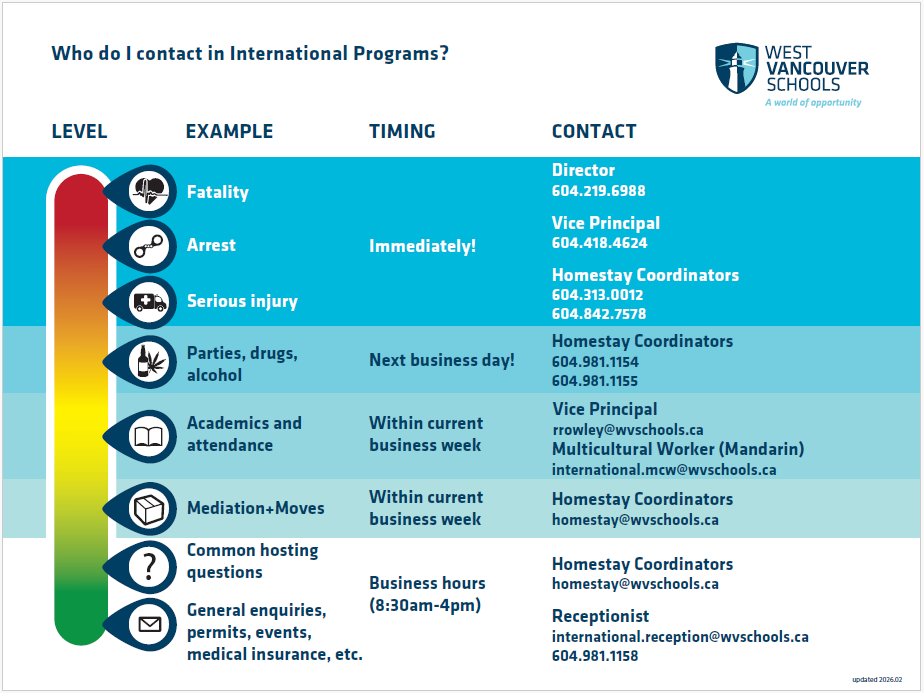
Who do I contact in an emergency?
What activities are planned by the International Program?
Please visit our website Things to do!
We encourage Homestay families to include their students on activities as well.
What happens during Winter and Spring Break?
Some students will choose to return to their home country or spend holidays with their own family.
If a student is staying here for holiday breaks,
host families are encouraged to include their student in plans and activities whenever possible.
Are students allowed to travel during their time in Canada?
Yes. We encourage students to travel and explore while they are here in Canada. Student travel policies and procedures are found on our webpage Accommodations Travel Policies and Procedures.
All students wanting to travel must receive prior permission by their natural parent and authorization through the International Program.
What is the application process to become a host family?
Submit the Application Form
Apply Now
Complete and submit the homestay application form. After submission, you will receive an automatic confirmation that your application has been received. Please note that submission of an application does not guarantee acceptance into the West Vancouver Schools International Program. Factors such as suitability of the household or commuting distance may affect eligibility.
Complete a Police Information Check (PIC)
Once your application has been reviewed, a Homestay Coordinator will contact you with instructions for obtaining the required Police Information Check.
Home Inspection
After the PIC is in progress, a home inspection will be scheduled to ensure the household meets program standards.
What are the policies regarding home security cameras?
Host families are expected to respect the privacy of their students at all times.
Any security cameras or other surveillance devices located in or around the home must be disclosed to the student upon arrival. Ideally, this information should also be included in the written house rules.
Surveillance equipment must be limited to common areas and must not interfere with the student’s privacy or their ability to move freely within shared spaces or their private bedroom.